Showing posts with label The Biz. Show all posts

Tuesday, July 7, 2009

The Future of Classic

After watching the second-season finale of Breaking Bad, the dramatic series about a chemistry-teacher-turned-meth-dealer desperate to not let his cancer treatment bankrupt his family, I had one thought: thank God this show is on AMC.
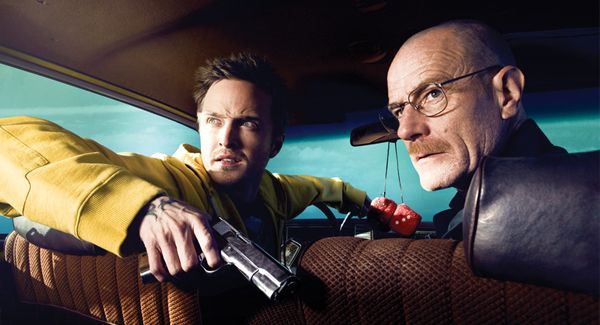
With the premiere of Mad Men two years ago, AMC went from musty movie channel to leading cable destination overnight. And now with the network's second dramatic series Breaking Bad attracting its fair share of critical acclaim (and even a leading-actor Emmy win for Bryan Cranston), AMC is establishing itself as a network that values quality over quantity. Unlike the broadcast networks, it has no reason to fill its primetime schedule with series each fall and hope that at least a few are commercial successes (let alone critical success). It has the freedom to develop series more thoroughly and thoughtfully.

And shows on AMC risk virtually no chance of cancellation. If a show on any of the big four networks pulled in Breaking Bad's numbers (around 1.4 million viewers on average), it would be axed instantly. But 1.4 million viewers, for a previously-obscure network like AMC, is a windfall. So with no threat of extinction—and a supportive network, to boot—AMC seems like a writer's and producer's paradise, as long as those writers and producers don't mind small audiences.

The second season of Breaking Bad was even edgier, more stimulating, and more tragic than the first. If this were a broadcast network show, I'd be sweating about whether a third season would ever transpire. But the show was renewed four episodes into last season. Thank God this show is on AMC.

On a technical note, I have widened the main column of this blog by 50% to allow for larger photos. Enjoy!

Wednesday, April 1, 2009

An Elegy for the Remote-Free

Fringe

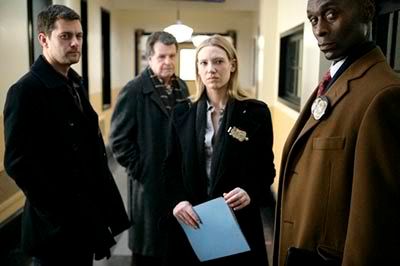
One of my favorite practices this season was Fox's "remote-free TV" model, in which the networks aired fewer commercials during each episode of Fringe and Dollhousewhile charging advertisers more for the exclusivityin an effort to keep viewers watching live, instead of recording the shows and fast-forwarding through the commercials. I liked it because, as a result, each episode's running time was 49 or 50 minutes, instead of just 42 or 43 minutes.

Unfortunately, the experiment had its share of setbacks, according to this article at Airlock Alpha. Even though viewers paid more attention to the ads, many companies were reluctant to shell out the extra bucks. Also, each episode was more expensive to produceand the extra minutes of each episode would be cut if the show was ever to air on another network.

I have to confess that I did nothing to help save the venture. I rarely watching anything live, unless it's some sort of viewing get-together with friends. The reduced number of ads simply meant less time through which to fast-forward.

However, I propose remote-free TV could work (and should be implemented) for shows like Dancing with the Stars or American Idol for a number of reasons: a) advertisers would gladly pay more since DWTS and Idol are huge ratings successes, b) it would reduce the running time of the show, especially if the producers trimmed some of the padding to fit those shows into an hour-long time slot, and, assuming that happened, c) other shows could be added to the lineup to fill those now-vacant time slots.

Networks, please have faith in remote-free TVif not for me and my selfish desires, then for the sake of packing more into your primetime hours.

Thursday, January 22, 2009

The Sophomore Slaughter

The "sophomore slump" occurs whenever the follow-up to a pop culture phenom fails to live up to the original. In the TV world, it occurs when the second season of a TV series doesn't match the quality of the first. Some shows weather this storm and continue on. Others are cancelled before they can even recover. And yet others are axed even if they don't fall victim to the slump—even if the second season is on a par with the first.

For some reason, I’m always surprised when shows are cancelled in their second seasons or later. To me, cancellation seems like the gauntlet that first-year shows run, and once they’re past that trial, they’ve earned the right to end on their terms—or, at least, end with a little advance notice. No such luck.

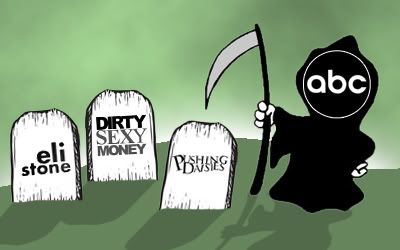
ABC reminded me of this misconception a couple of months ago with the sudden (and simultaneous) cancellation of three sophomore series: Pushing Daisies, Eli Stone, and Dirty Sexy Money. I hadn’t gotten into Dirty Sexy Money, but I was a big fan of the other two. And this move by ABC—cancelling three series in one fell swoop—struck me as particularly ruthless. At least when shows are cancelled individually, I can pretend like it was a hard decision for the network to make. But when three shows are cancelled at once, it just seems to me like the network just made a snap business decision regardless of each show’s merits. What a stark reminder of just how much of a numbers game the TV biz is.